Listen
Hear the phrases families actually use, in one carefully reviewed voice.
Spoken Levantine Arabic, for children
Spoken Levantine Arabic that helps children talk naturally with the people they love — starting from the first lesson. The voice is Lebanese, understood from Beirut to Damascus to Amman to Jerusalem.
First 4 lessons free. No card to start.
Levantine Arabic as families actually speak it - understood from Beirut to Damascus to Amman - reviewed word by word by a native ear, and re-recorded whenever that ear says no.
Press any line — a real conversation from lesson one, and it needs no account.
Teta picks up
marhaba
Hello
Your child learns the top line. The alphabet is there if they ever want it, and it is never required for anything.
Simple from the first tap
Hear the phrases families actually use, in one carefully reviewed voice.
Practice aloud with phonetic spelling, without waiting to master the alphabet.
Build from greetings into the conversations children want with family.
No card required.
One plan for your whole family.
Up to three children get full access to every lesson, plus all new lessons and levels we add.
$9.99/monthor$89.99/year
Choose yearly and get about three months free.
Cancel any time. Your first payment has a 14-day refund window. Refund terms · Billing help
Start freeEvery lesson is a stop on one road. Every phrase they say earns one, two or three stars for how closely it sounded - each with its own ding - and the stars land in their own chest. Tapping it opens what they stand for, so they can hear the words again in the voice they learned them in.
One road to fluency. Four levels, 90 lessons.
What a child collects is counted honestly: up to three stars a phrase, for how closely they said it, and nothing on the page can ever take one back.
Beginner · 26 lessons
The first hellos, please and thank you, the family, food at the table, counting and their age, colors - the words a child needs to belong at the family table.
Intermediate · 26 lessons
The big family visit: Teta's kitchen, the beach, the little shop and its money, telling the time - then coming home and telling the story of it all, with opinions of their own.
Advanced · 26 lessons
A year in their life: the seasons and the weather, days and months, birthdays and feasts, the pharmacy and the village, plans with friends - their Arabic becomes a personality, not a subject.
Sound Like Family · 12 lessons
The finale: joining the fast family room, understanding its sayings and humour, carrying its stories, and speaking with warmth that feels like home.
The road opens level by level, always ahead of the fastest family — and one plan covers all of it, today’s lessons and every level to come.
One card at a time
A lesson is a walk, not a page to scroll. One phrase in front of them, heard in the certified voice, said back into the microphone - and only then does the next step open. There is no scrolling through: every phrase is met out loud, an accent always passes, and nothing is ever asked more than twice.
Then a check they can pass
At the end of the lesson the voice plays a phrase back and they pick what it means, from three. Only words from the lesson they have just done -11 phrases in, on their first day - and nothing is scored.
And you can read it
Everything they say into the microphone becomes text only long enough to recognise the attempt, then it is dropped. There is no voice library and no conversation record. The Family page keeps only what helps them continue: their progress and best stars.
No streaks. No daily goal. No timer, no counter that resets, no badge to protect and nothing that expires. Put it down for a month and it is exactly where you left it, with nothing to apologise for and nothing to catch up on.
That is not a setting we let you turn off - it is how the product is built. There is no streak anywhere in it to break, so there is nothing for a child to be anxious about and nothing for you to police at bedtime. Children get enough of the other thing at school.
Four steps, about five minutes, and every one of them says why it is asking.
Create your account
The account is yours, not your child’s. No child ever has a login here.
Confirm your email
One tap in your inbox, whenever suits. It is how you get back in if you forget your password, and it lifts the daily free limit. The first lesson does not wait for it.
Set up their profile
One form: a first name, an age, and whether to teach them the boy or girl forms - Arabic changes “I am hungry” depending on who is speaking, so that is grammar rather than a category. It also asks who is at home (Teta, jiddo, a brother by name), so the lessons are about their family instead of a stranger’s.
Open the first lesson together
Ten minutes, and they will have said something real out loud. It starts with the first hello.
Everything is written the way it sounds - marhaba, keefak, mneeh. The Arabic alphabet is there for a curious child and is never required for anything, so a seven-year-old is talking in the first ten minutes instead of learning letters for a term.
You tell us who is at home and the lessons use those names - Teta by name, their own brother, their cousin. Arabic changes for a girl and a boy, and for which side of the family an aunt is on, and we get all of it right rather than teaching one version to everybody.
Your child can speak from their first lesson - that is the whole point of this. A recording is sent only while they hold the button, turned into text so the app can recognise the attempt, and then dropped. There is no library of your child’s voice in this product, because we never keep one.
One tap on the Family page gives you a readable copy of everything we hold - your account, each child, their family details and their road - and another, with your password, deletes all of it. Neither asks you to email anybody or wait for a reply.
The whole of it is in the privacy notice and the terms, both written to be read.
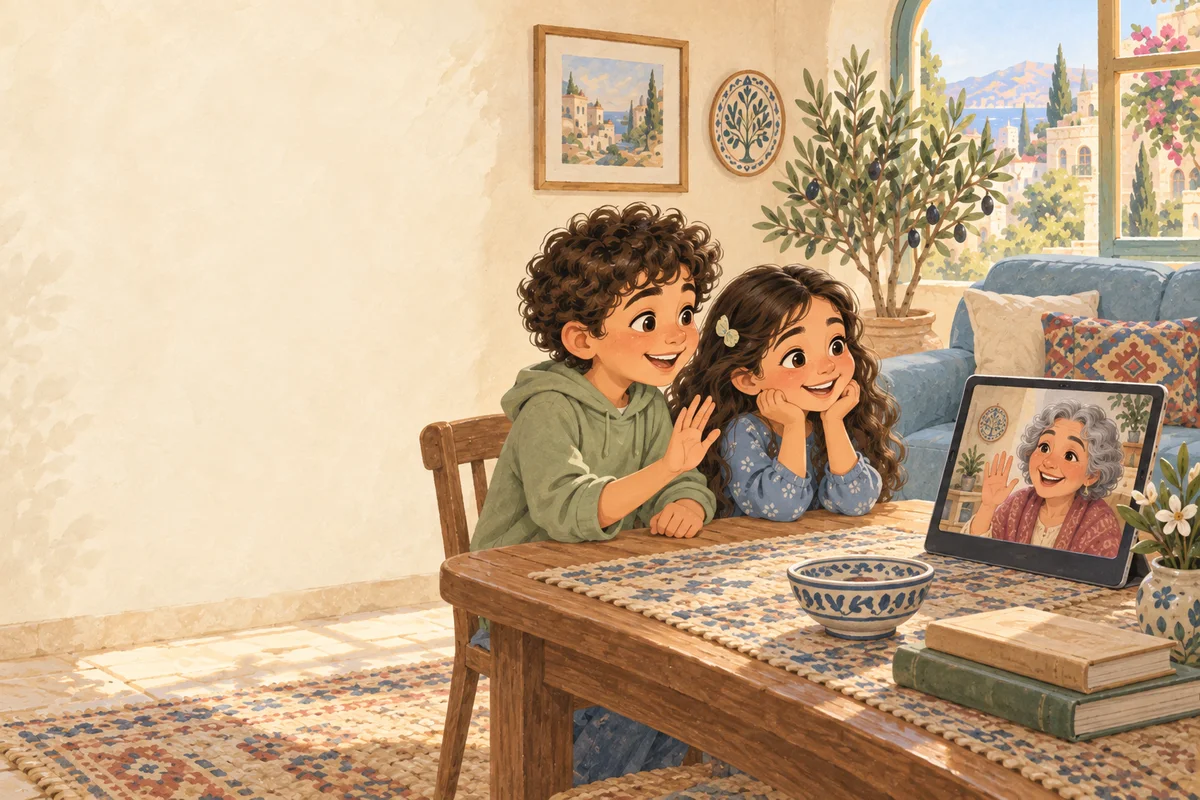
Every family living abroad knows this phone call.
The screen lights up with home. Everyone gathers. And then Teta asks the little one a question — and the little one just stares at you, waiting to be rescued.
That was my house, for years. Fifteen years abroad, and my son and daughter understood pieces of every call but couldn’t answer a single word. My son wouldn’t learn through the Arabic alphabet — and honestly, I understood him. Meanwhile the people who love my children most were slowly becoming polite strangers to them: Teta, Jeddo, the cousins, the aunts and uncles — all that love on one side, all that silence on the other, and an ocean in between that we couldn’t cross every year.
So I built what I couldn’t find: the Arabic that families actually speak — warm, spoken, no alphabet in the way. My own two kids were my first students, and my own ear certifies every word you’ll hear.
Now when home calls, my children answer it themselves. And when we finally visited my country, they walked in confident — greeting, asking, joking, holding their own in a place where almost no one speaks their English. Not translated by their mother. Independent.
No fear. No staring at me. Just family, finally talking.
– N.R.
If that phone call happens in your house too — this was built for yours.